

From Erenhot to Ulaanbaatar: Where My Train Dream Began

How Many Steps Does It Take to Travel by Train from China to Mongolia?
My journey looked like this:
- First, I snagged a “blind box” ticket with China United Airlines from Beijing to Erenhot for about 500 RMB one-way.
- Then I crossed the border by land from Erenhot into the Mongolian border town of Zamiin-Uud.
- From there, I boarded the K3 train for a segment of the journey to Mongolia’s capital, Ulaanbaatar.
All in all, the trip took about 24 hours.
The K3 railway—stretching across China, Mongolia, and Russia—was once the origin of my train dream. Unfortunately, for various reasons, it’s no longer possible to experience the entire route in one go. I couldn’t witness the iconic midnight moment when the train is lifted at the border to change its bogies. Still, traveling it in segments is better than not at all.
Before leaving, someone asked me: Why bother going to Mongolia? Xinjiang and Inner Mongolia in China have autumn scenery just as beautiful, with far better infrastructure.
But I couldn’t resist. The desolation and mental emptiness of riding that long-dreamed-of train through the Mongolian Gobi—that was the real temptation. It was the train itself that finally brought me face to face with this quiet, often-overlooked neighboring country.
A Train Ride
I chose the overnight train from Zamiin-Uud to Ulaanbaatar, departing at 6 p.m. and arriving at the capital’s station around 9 a.m. the next morning.
First came the land crossing: a bus ride from Erenhot through the border checkpoint. Despite the distance between the two border cities being only nine kilometers, the process took a full three hours—inefficient and chaotic. Apart from a few Chinese backpackers on holiday, most passengers were Mongolians hauling massive bags filled with Made-in-China goods.
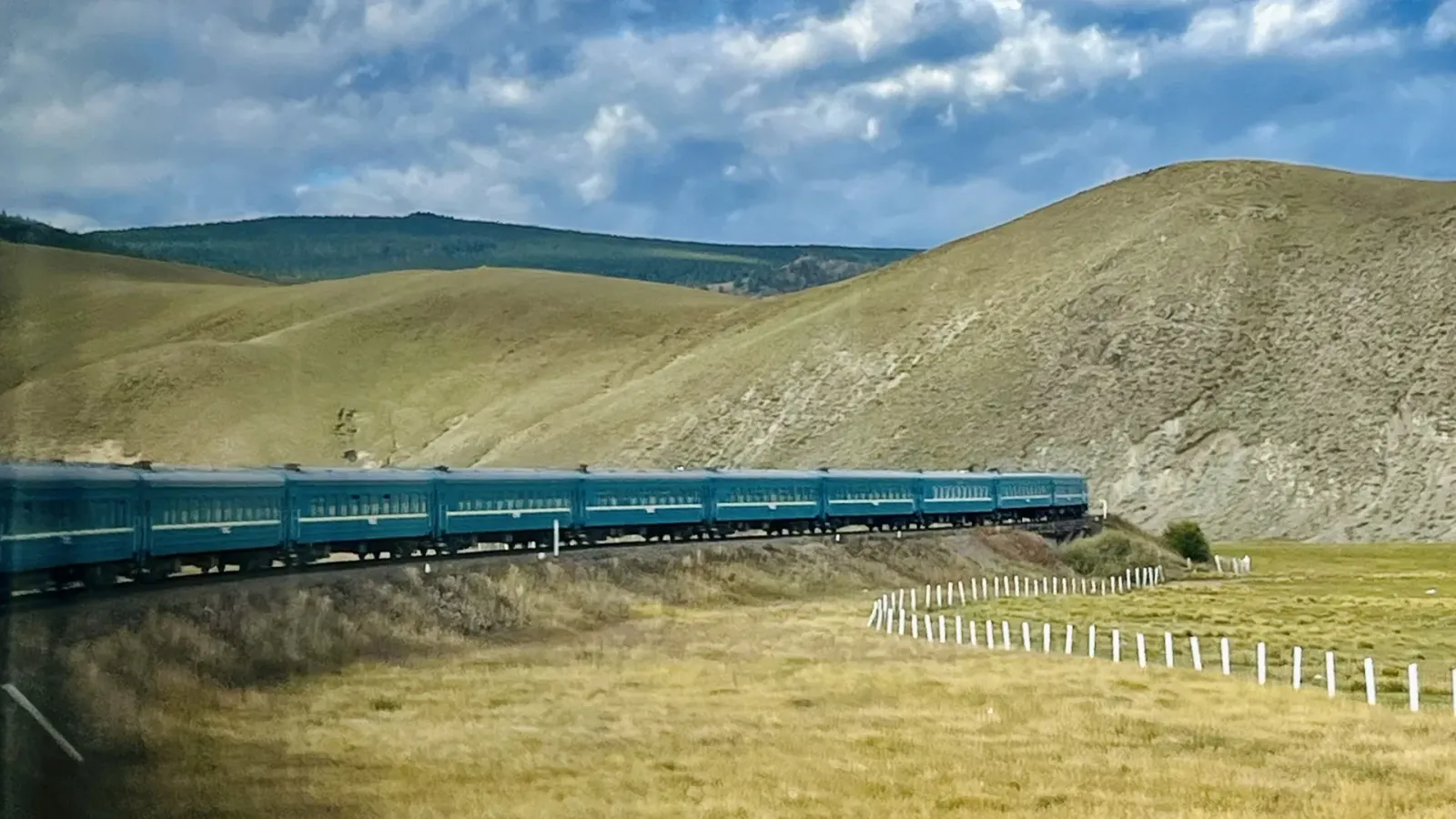
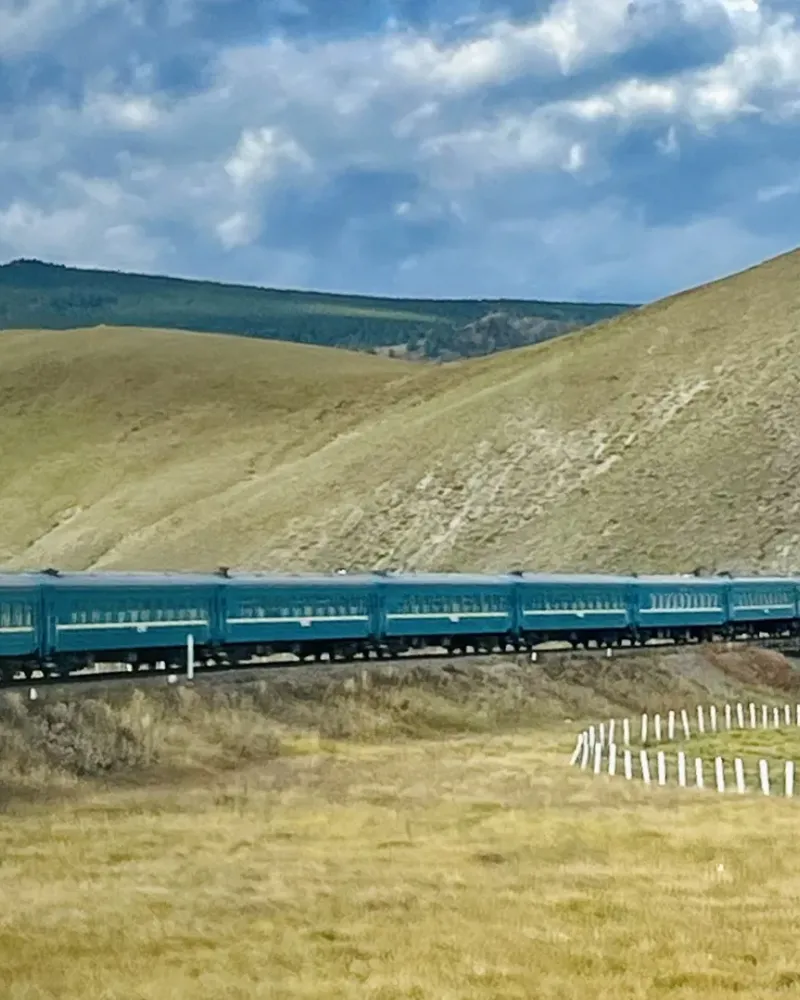
At sunset, I boarded a green, Soviet-style train—loud, heavy, and mechanical. The conductors were still pouring water into the boiler. As the train chased the golden sunset across the Gobi, a middle-aged conductor suddenly shouted in Mongolian: “Close the window!” She was absolutely right. By the time I checked the upper bunk, it was already covered in sand.
Once inside Mongolia, everything felt colder and harsher. The entire country has just over three million people, with nearly half living in Ulaanbaatar. Outside the windows, human presence was rare, and the train’s roar echoed even louder across the open wilderness. Along the way, the only two notable cities were Sainshand and Choir.
With the signal cutting in and out, how does one pass the night? Luckily, two Chinese uncles working in Mongolia shared the compartment with me, filling the hours with stories and anecdotes. Later, I wandered to the dining car for a simple Mongolian-style meal. Only when the night grew quiet did I realize the downside of good company—snoring at full volume.
The Coldest Capital in the World
At 8 a.m., I pulled back the curtains. The train was still embraced by grassland, but the outline of the city was already visible in the distance.
Ulaanbaatar, deep in inland Northeast Asia, has a temperate desert climate and is known as the coldest capital city in the world. Stepping off the train, surrounded by early Soviet architecture and Cyrillic letters, the station felt raw and heavy. A sharp gust of wind blew through, and for a moment, the men in long coats nearby looked eerily like figures from a dystopian novel.
The city’s infrastructure resembles that of a small Chinese city from over a decade ago. Even on main roads, potholes are everywhere. When the wind picks up, sand fills your eyes instantly. Mongolia is notorious for sandstorms, and its environmental problems affect northern China as well.
There are no official taxis in the city—only unlicensed cars you flag down by hand. Ride-hailing apps have recently launched, but in practice, few drivers are willing to pick up passengers. The whole city feels loose and unhurried, forcing you into an extended city walk.
Using Sükhbaatar Square as the center, everything you need—museums, monuments, markets, government buildings, neighborhoods, souvenir shops, and local food—lies within a three-kilometer radius.
Downtown carries a hint of cosmopolitan flair: massive LED billboards, fashionable girls in sunglasses, young people riding flashy mountain bikes, and surprisingly polished international signage.
Economic ties with South Korea and Japan are strong. CU, GS25, and Emart convenience stores line the streets. Kias and Toyotas dominate the roads, with left-hand and right-hand drive cars mixed together. Used cars can be imported freely, with few restrictions on engine size, which explains why you often see Japanese models that have long vanished from Chinese roads.
Many cars are missing windows, have cracked headlights, or dented rear ends. When asked why, locals explained that Mongolia lacks a comprehensive auto insurance system—or that claims are simply too expensive. Imported cars are cheap (around 20,000–30,000 RMB), so when one breaks down, people often just buy another.
A Conversation
On the first day of the train journey, I met a 24-year-old Mongolian guy named Tmiraa—educated in Sweden, with an exchange experience in the U.S. By Mongolian standards, he’s likely in the top 0.5%.
He’s also an “Always Walking” kind of person. We talked nonstop about adventures and the wider world. One sentence he said stayed with me: “We are all world citizens. We should be free to choose any country or city to live in, without judgment or obstruction.”
That night, he took us to Zaisan Memorial to overlook “Ulaanbaatar Nights.” “I don’t know why this song is so popular,” he laughed, “but every Chinese friend I know hums it for me.”
He warned us against walking alone late at night in Mongolia—regardless of gender. He once had his nose broken by a drunk on the street. Broken bottles are everywhere. Not long after this conversation, a drunk tossed a still-burning cigarette butt at me.
Due to excessive alcohol consumption nationwide, Mongolia has designated the first day of each month as a no-alcohol day—no sales in supermarkets or bars.
A Road Trip Across the Plateau
On my second-to-last day, I joined some friends I’d met at the border and rented a car for an autumn road trip across the Mongolian Plateau. Our route was: Ulaanbaatar → Genghis Khan Statue → Terelj National Park → Aryabal Temple
Along the way, herders were already preparing for seasonal migration. It reminded me of the documentary “The Weather Is Fine on the Mongolian Grasslands”—of Puji, whose life froze at age twelve, and Grandma Suren, whose smile slowly faded.
Our driver was a Mongolian woman, her round face always flushed with warmth. Despite the language barrier, Mongolian music in the car gradually dissolved the awkwardness, making the journey lighter.
The first stop was the Genghis Khan Equestrian Statue—a 40-meter-tall, 250-ton stainless steel monument, the largest equestrian statue of Genghis Khan in the world, completed in 2008. Inside, an elevator takes you up to a viewing platform on the horse’s head, overlooking the autumn landscape. The first and basement floors host exhibitions on Mongolian history.
Most visitors were South Koreans on Chuseok holiday, along with some Mongolian student groups. When they saw us, they smiled brightly and asked in broken Korean if we were Korean. When I shook my head and said we were Chinese, the smiles vanished instantly—a contrast that left me with a less favorable impression of Mongolian hospitality.
At lunchtime, our driver took us to a herder’s home. Dumplings, offal soup, lamb rib rice, and lamb fried rice—all for just over 100 RMB. Hot milk tea came with the meal. Mongolian cuisine relies heavily on meat, dairy, and wheat; leafy greens are rare, but the calories are plentiful. After eating, we spent the afternoon bouncing around the chilly grasslands, energized and carefree.
Terelj National Park, about 60 kilometers from the city, features towering mountains, flowing rivers, and a unique autumn beauty rivaling summer. With low commercialization, the landscape feels pure and unspoiled. Along the way, we saw newly built resorts and camps, as well as herders waiting roadside with horses, cows, and eagles. For about 30 RMB, you can get up close with these grassland animals.
After visiting the iconic Turtle Rock, one of my companions suggested visiting a nearby monastery. A bumpy dirt road led us to Aryabal Temple. From the parking area at the mountain’s base to the temple gate at the top lay over 100 steps. Legend says that for each step climbed while chanting “Om Mani Padme Hum,” one’s sins are reduced. Devout pilgrims climbed alongside us, and philosophical verses lined the stairway.
At sunset, we dropped off one companion at a herder’s home, where she would spend the night. Finding the yurt wasn’t easy—no road names, no addresses, only GPS. We crossed a stream and briefly thought we were lost, until our driver decisively floored the gas. The old Toyota leapt across the water effortlessly. Truly, the Mongolians are born warriors.

Co-founder and and lead writer of Yonder Song, covering city culture and practical route design for independent travelers.
Leave a comment
0